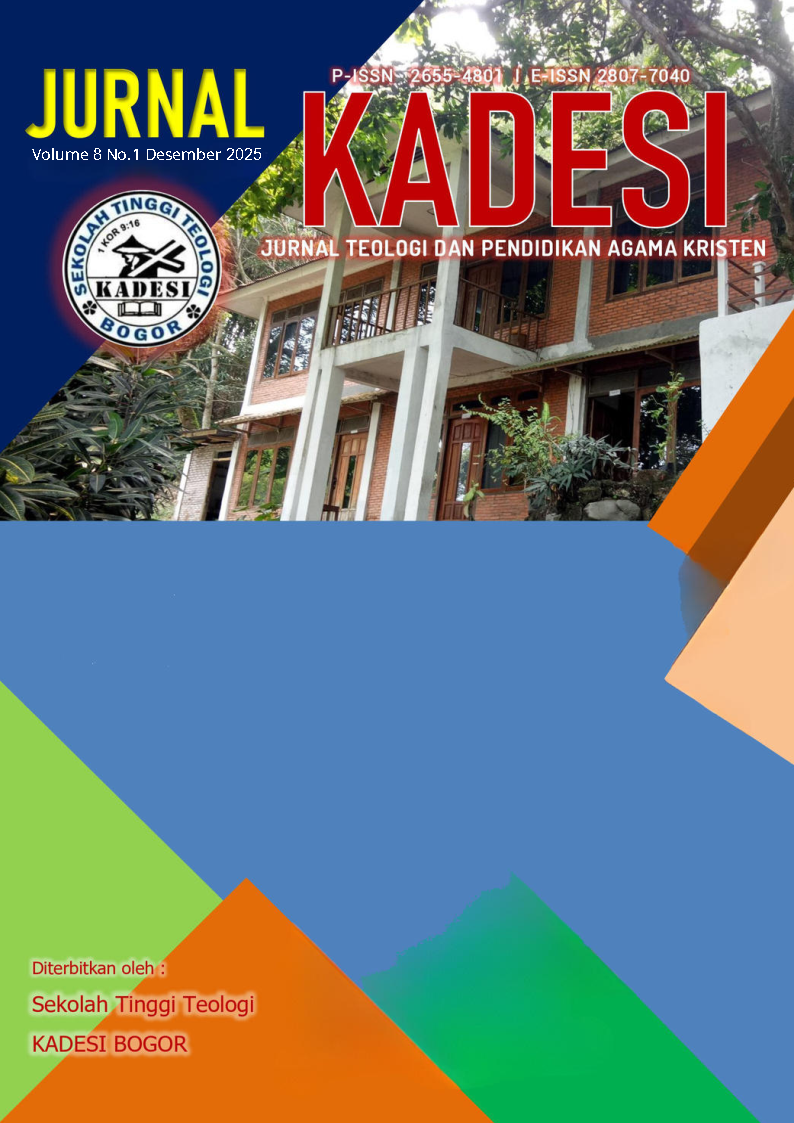
Pengaruh Intensitas Interaksi Sosial Media Bermuatan Kristiani Terhadap Pembentukan Karakter Peserta Didik Di SMPN 1 Cikampek
DOI:
https://doi.org/10.54765/ejurnalkadesi.v8i1.151Keywords:
intensitas interaksi, media sosial, konten Kristiani, pembentukan karakter, peserta didik, SMPN 1 Cikampek.Abstract
Social media and teenagers are inseparable. It is undeniable that the sophistication of features found on various devices has made all thoughts and activities at least in contact with devices. The spiritual life of Christian congregations, including teenagers, is often influenced by various external factors, including social media, therefore research is needed to determine the intensity of Christian social media interactions on the character development of students. This research is a quantitative descriptive research with primary data sources obtained from the results of questionnaires from the sample, namely all Christian students at SMPN 01 Cikampek, data obtained from questionnaire entries were analyzed by testing validity, reliability, and correlation between research variables. The results showed that a total of 22 (61%) samples often accessed Christian content. The correlation results show a result of 0.369 with a significance value of 0.027, this shows a weak and significant relationship that students who often access Christian content have good character development. If social media is used wisely and directed sufficiently to Christian content then character development will be good.
References
Adnyana, I. M. D. M. Metode Penelitian Pendekatan Kuantitatif. Edited by T. S. Tambunan. Bandung: CV Media Sains Indonesia, 2021.
Arikunto, Suharsimi. Metode Penelitian R&D. Bandung: CV Alfabeta, 2016.
Awang, J. A., I. S. P. Prayitno, and J. D. Engel. “Strategi Pendidikan Agama Kristen bagi Remaja dalam Membentuk Konsep Diri guna Menghadapi Krisis Identitas akibat Penggunaan Media Sosial.” Kharismata: Jurnal Teologi Pantekosta 4, no. 1 (2021): 98–114.
Badan Pusat Statistik. Survei Sosial Ekonomi Nasional (SUSENAS) 2022. Jakarta: Badan Pusat Statistik, 2022.
Bitanti, Ilo Maila. Pengaruh Intensitas Penggunaan Media Sosial terhadap Religiusitas Peserta Didik di MAN Negeri 1 Natar. Lampung: UIN Raden Intan Lampung, n.d.
Ghozali, Imam. Aplikasi Analisis Multivariate dengan Program SPSS. Semarang: Badan Penerbit Universitas Diponegoro, 2015.
———. Aplikasi Analisis Multivariate dengan Program IBM SPSS 26. 10th ed. Semarang: Badan Penerbit Universitas Diponegoro, 2021.
Ginanjar, Syamsuar. Modul Workshop Statistik (EKM235): Analisis Data Non-Parametrik. Jakarta: STIE Indonesia Jakarta, 2020.
Gustia, I., and M. Yuria. “Dampak Media Sosial di Masa Pandemi Covid-19 terhadap Perilaku Seksual Remaja.” Sembadha 2 (2021): 304–308.
Junaedi, Fajar. Etika Komunikasi di Era Siber: Teori dan Praktik. Jakarta: PT RajaGrafindo Persada, 2019.
Kolang, and Yesika. “Pendidikan Agama Kristen Remaja dan Aktualisasi Diri Menurut Abraham Maslow terhadap Pembangunan Mental Remaja di Era Society 5.0.” Jurnal Apokalupsis 15, no. 1 (June 2024).
Nasrullah, Rulli. Media Sosial: Perspektif Komunikasi, Budaya, dan Sosioteknologi. Bandung: Remaja Rosdakarya, 2017.
Sugiyono. Metode Penelitian Kombinasi (Mix Methods). Bandung: Alfabeta, 2015.
———. Metode Penelitian Kuantitatif, Kualitatif, dan R&D. Bandung: Alfabeta, 2021.
———. Metode Penelitian Kuantitatif dan Kualitatif. Bandung: CV Rosdakarya, 2021.
Supratman, L. P. “Penggunaan Media Sosial oleh Digital Native.” Jurnal Ilmu Komunikasi 15, no. 1 (2018): 47–60.
Yuniarti, Zulfa. Riset: Benarkah Media Sosial Berpengaruh terhadap Rentang Fokus Remaja? Bandung: Indonesia Heritage Foundation, 2025.
Downloads
Published
How to Cite
Issue
Section
License
Copyright (c) 2025 JURNAL KADESI

This work is licensed under a Creative Commons Attribution-ShareAlike 4.0 International License.
Open Access Policy & License
All research articles published in JURNAL KADESI: Jurnal Teologi dan Pendidikan Agama Kristen are fully open access: immediately freely available to read, download and share. Articles are published under the terms of aCreative Commons Attribution-ShareAlike 4.0 International License which permits use, distribution and reproduction in any medium, provided the original work is properly cited.
Definition of Open Access Publication from Bethesda Statement on Open Access Publishing: An Open Access Publication [1] is one that meets the following two conditions:
- The author(s) and copyright holder(s) grant(s) to all users a free, irrevocable, worldwide, perpetual right of access to, and a license to copy, use, distribute, transmit and display the work publicly and to make and distribute derivative works, in any digital medium for any responsible purpose, subject to proper attribution of authorship, as well as the right to make small numbers of printed copies for their personal use.
- A complete version of the work and all supplemental materials, including a copy of the permission as stated above, in a suitable standard electronic format is deposited immediately upon initial publication in at least one online repository that is supported by an academic institution, scholarly society, government agency, or other well-established organization that seeks to enable open access, unrestricted distribution, interoperability, and long-term archiving.

This work is licensed under a Creative Commons Attribution-ShareAlike 4.0 International License.